Pete Sampras Stats, Age, Height, Career, Profile, Wife, Titles, Family & Net Worth
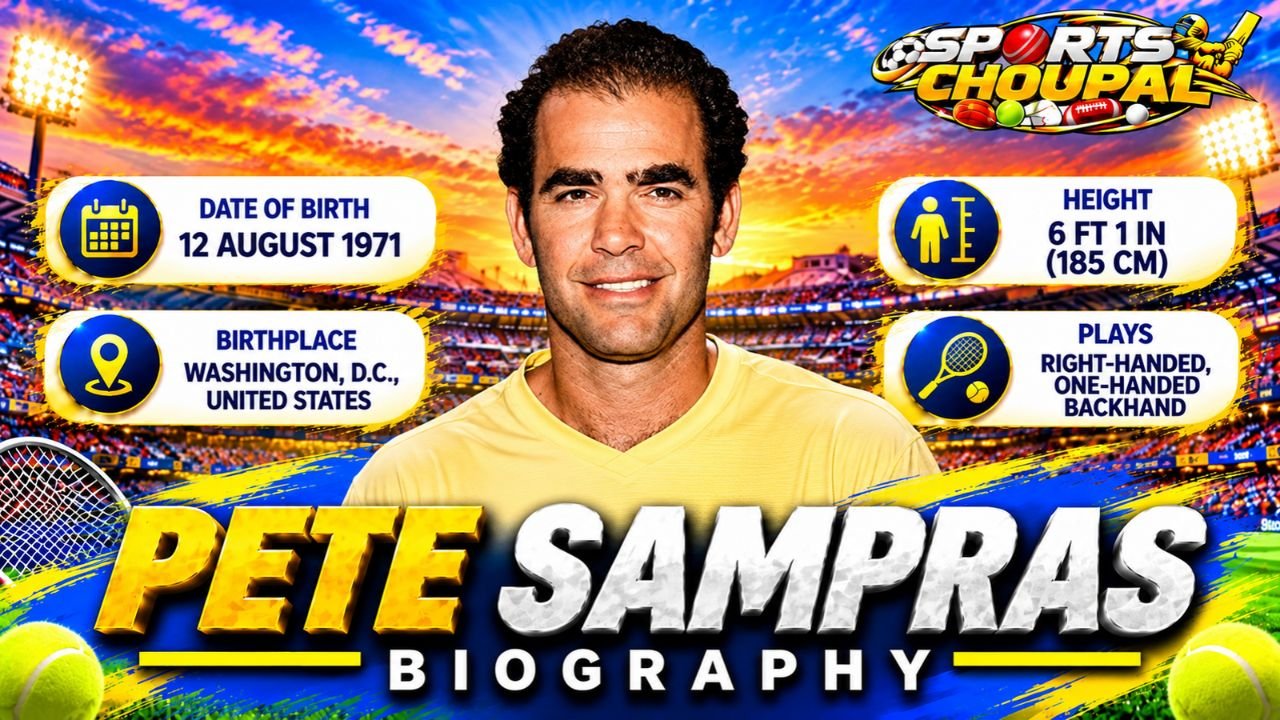
Pete Sampras is a former world No. 1 tennis player. Fans call him “Pistol Pete.” He dominated men’s tennis in the 1990s. He retired with 14 Grand Slam men’s singles titles. That mark stood as the all-time record for years. Looking for Pete Sampras stats and age? This article also covers his wife, Bridgette Wilson-Sampras, his family, his titles, and his net worth. It shows the numbers and the story behind them.
Pete Sampras Profile
| Attribute | Detail |
| Full Name | Petros Sampras |
| Nickname | Pistol Pete |
| Date of Birth | 12 August 1971 |
| Age | 55 years (as of November 2026) |
| Birthplace | Washington, D.C., USA |
| Current Residence | Lake Sherwood and Westlake Village area, Southern California |
| Height | 6 ft 1 in (1.85 m) |
| Weight | 174 lb (79 kg) |
| Plays | Right-handed, one-handed backhand |
| Turned Pro | 1988 |
| Retired | 2003 (official announcement on 25 August 2003) |
| Career-High Ranking | World No. 1 (first reached 12 April 1993) |
| Weeks at No. 1 | 286 |
| Grand Slam Titles | 14 |
| Hall of Fame | International Tennis Hall of Fame, inducted July 2007 |
| Wife | Bridgette Wilson-Sampras |
| Coaches | Peter Fischer, Joe Brandi, Tim Gullikson, Paul Annacone, Tom Gullikson, José Higueras |
Pete played a serve-and-volley game. His serve was among the best of his era. He attacked on fast surfaces. Fans remember his calm focus and his big moments under pressure.
Pete Sampras Early Life
Petros Sampras was born on 12 August 1971 in Washington, D.C. His father, Soterios “Sammy” Sampras, was born in the United States to a Greek father and a Polish-Jewish mother. His mother, Georgia Vroustouris, immigrated from Sparta, Greece.
At age three, Pete found a tennis racket in his basement. He spent hours hitting balls against a wall. In 1978, his family moved to Palos Verdes, California. The warm climate let him play all year.
Pete trained with coach Robert Lansdorp. Lansdorp built his flat, driving forehand. Pete also trained with pediatrician and coach Dr. Peter Fischer. At age 13, Fischer made a difficult decision. He switched Pete from a two-handed backhand to a one-handed backhand. The change aimed to help him win Wimbledon.
Pete left high school at 16 or 17 to turn pro. He started his pro career ranked outside the top 800. He finished his first year inside the top 100.
Pete Sampras Family
Pete’s family shaped his personal life. His parents built a home full of sports. His sister and brother also played key roles in his life and career.
| Relation | Name | Details |
| Father | Soterios “Sammy” Sampras | Born in the United States to a Greek father and a Polish-Jewish mother |
| Mother | Georgia Sampras (née Vroustouris) | Immigrated from Sparta, Greece |
| Sister | Stella Sampras | Longtime head women’s tennis coach at UCLA |
| Brother | Gus Sampras | Helped manage Pete’s wealth for decades |
| Wife | Bridgette Wilson-Sampras | Married 30 September 2000 |
| Son | Christian Charles Sampras | Born 21 November 2002 |
| Son | Ryan Nikolaos Sampras | Born 29 July 2005 |
Pete’s sister Stella remains active in the sport. Her nieces compete in NCAA college tennis. Pete spends most of his time now with his family.
Pete Sampras Wife: Bridgette Wilson-Sampras
Pete married actress Bridgette Wilson on 30 September 2000. The couple met in 1999. They dated for nine months before the wedding. Bridgette was born on 25 September 1973 in Gold Beach, Oregon. She won Miss Teen USA in 1990.
Bridgette built a film career in the 1990s and 2000s. She starred in several popular films. She left Hollywood in the late 2000s to focus on family life.
| Film | Role |
| Billy Madison | Veronica Vaughn |
| Mortal Kombat | Sonya Blade |
| I Know What You Did Last Summer | Cast member |
| Last Action Hero | Cast member |
| The Wedding Planner | Cast member |
Bridgette’s Health
In October 2023, Pete shared a public statement about his wife. Bridgette had been diagnosed with ovarian cancer in December 2022. She had major surgery and chemotherapy. She then continued targeted maintenance therapy. The family keeps her recovery details private. Pete has dedicated much of his time to supporting her and their sons.
Pete Sampras Career Timeline
Pete’s career ran from 1988 to 2002. He won major titles across the 1990s. His timeline shows the key moments of each year.
| Year | Highlights |
| 1988 | Turned pro at 16 or 17; finished inside the top 100 |
| 1989 | First Grand Slam match wins; beat Mats Wilander at the US Open |
| 1990 | First ATP title in Philadelphia; won the US Open at 19 years and 28 days, the youngest US Open men’s champion |
| 1991 | Won four titles, including the first ATP World Championship |
| 1992 | Won five titles; first Masters 1000 title in Cincinnati; represented the U.S. at the Barcelona Olympics; helped the U.S. win the Davis Cup; lost the US Open final to Stefan Edberg |
| 1993 | Reached World No. 1 on 12 April; won Wimbledon and the US Open; served 1,011 aces, the first player to top 1,000 in a season |
| 1994 | Won 10 titles; won his first Australian Open and defended his Wimbledon title |
| 1995 | Won Wimbledon and the US Open; won a second Davis Cup title; continued through his coach’s brain tumor diagnosis |
| 1996 | Reached the French Open semifinals, his best clay result; won the US Open over Michael Chang |
| 1997 | Won eight titles without losing a final; won the Australian Open and Wimbledon |
| 1998 | Won his fifth Wimbledon title; finished the year as No. 1 for a sixth straight year |
| 1999 | Won his sixth Wimbledon title over Andre Agassi |
| 2000 | Won his seventh Wimbledon title and 13th Grand Slam title, passing Roy Emerson’s record of 12 |
| 2001 | Went without an ATP title for the first time since 1989; lost to Roger Federer at Wimbledon; lost the US Open final to Lleyton Hewitt |
| 2002 | Won his 14th Grand Slam title at the US Open, beating Andre Agassi in the final |
| 2003 | Retired; announced his retirement at the US Open |
1990: The Youngest US Open Champion
In 1990, Pete beat Ivan Lendl, John McEnroe, and Andre Agassi at the US Open. He became the youngest male US Open champion in history. He was 19 years and 28 days old.
1995: Emotional Resilience
Pete’s coach and close friend, Tim Gullikson, collapsed with a brain tumor during the 1995 Australian Open. Pete cried during his quarterfinal against Jim Courier. He rallied to win the match. He then went on to win Wimbledon and the US Open that year.
2002: The Storybook Ending
Pete went through a 33-tournament title drought. His ranking had fallen. He still caught fire at the 2002 US Open. He beat Tommy Haas, Andy Roddick, and Sjeng Schalken. He beat Andre Agassi in the final in four sets. That win gave him his 14th Grand Slam title.
Pete Sampras Grand Slam Finals
Pete’s finals record stands at 14 wins and 4 losses. He went 7–0 in Wimbledon finals.
| Year | Tournament | Opponent | Outcome | Score |
| 1990 | US Open | Andre Agassi | Win | 6–4, 6–3, 6–2 |
| 1992 | US Open | Stefan Edberg | Loss | 6–3, 4–6, 6–7(5), 2–6 |
| 1993 | Wimbledon | Jim Courier | Win | 7–6(3), 7–6(6), 3–6, 6–3 |
| 1993 | US Open | Cédric Pioline | Win | 6–4, 6–4, 6–3 |
| 1994 | Australian Open | Todd Martin | Win | 7–6(4), 6–4, 6–4 |
| 1994 | Wimbledon | Goran Ivanišević | Win | 7–6(2), 7–6(5), 6–0 |
| 1995 | Australian Open | Andre Agassi | Loss | 6–4, 1–6, 6–7(6), 4–6 |
| 1995 | Wimbledon | Boris Becker | Win | 6–7(5), 6–2, 6–4, 6–2 |
| 1995 | US Open | Andre Agassi | Win | 6–4, 6–3, 4–6, 7–5 |
| 1996 | US Open | Michael Chang | Win | 6–1, 6–4, 7–6(3) |
| 1997 | Australian Open | Carlos Moyá | Win | 6–2, 6–3, 6–3 |
| 1997 | Wimbledon | Cédric Pioline | Win | 6–4, 6–2, 6–4 |
| 1998 | Wimbledon | Goran Ivanišević | Win | 6–7(2), 7–6(9), 6–4, 3–6, 6–2 |
| 1999 | Wimbledon | Andre Agassi | Win | 6–3, 6–4, 7–5 |
| 2000 | Wimbledon | Patrick Rafter | Win | 6–7(10), 7–6(5), 6–4, 6–2 |
| 2000 | US Open | Marat Safin | Loss | 4–6, 3–6, 3–6 |
| 2001 | US Open | Lleyton Hewitt | Loss | 6–7(4), 1–6, 1–6 |
| 2002 | US Open | Andre Agassi | Win | 6–3, 6–4, 5–7, 6–4 |
Pete’s 77.8 percent win rate in Grand Slam finals ranks among the best for men with at least 10 finals.
Pete Sampras Grand Slam Progression
| Tournament | 1988 | 1989 | 1990 | 1991 | 1992 | 1993 | 1994 | 1995 | 1996 | 1997 | 1998 | 1999 | 2000 | 2001 | 2002 | Titles / Played |
| Australian Open | A | 1R | 4R | A | A | SF | W | F | 3R | W | QF | A | SF | 4R | 4R | 2 / 11 |
| French Open | A | 2R | A | 2R | QF | QF | QF | 1R | SF | 3R | 2R | 2R | 1R | 2R | 1R | 0 / 13 |
| Wimbledon | A | 1R | 1R | 2R | SF | W | W | W | QF | W | W | W | W | 4R | 2R | 7 / 14 |
| US Open | 1R | 4R | W | QF | F | W | 4R | W | W | 4R | SF | A | F | F | W | 5 / 14 |
Key: W = Winner, F = Finalist, SF = Semifinalist, QF = Quarterfinalist, 1R to 4R = Rounds 1 to 4, A = Did not play.
Pete Sampras Titles
Pete won 64 singles titles from 88 career finals. That is a 72.7 percent win rate in finals. Only three of those titles came on clay.
| Breakdown | Titles |
| Grand Slam Titles | 14 (Wimbledon 7, US Open 5, Australian Open 2) |
| Year-End Championships | 5 (1991, 1994, 1996, 1997, 1999) |
| Grand Slam Cup | 2 (1990, 1997) |
| Masters 1000 | 11 |
| Other Singles Titles | 32 |
| Total Singles Titles | 64 |
| Doubles Titles | 2 |
Masters 1000 Titles
- Indian Wells: 1994, 1995
- Miami: 1993, 1994, 2000
- Rome: 1994
- Cincinnati: 1992, 1997, 1999
- Paris Indoor: 1995, 1997
All 64 Singles Titles
| No. | Date | Tournament | Surface | Final Opponent | Score |
| 1 | Feb 1990 | Philadelphia | Carpet | Andrés Gómez | 7–6(4), 7–5, 6–2 |
| 2 | Jun 1990 | Manchester | Grass | Gilad Bloom | 7–6(9), 7–6(3) |
| 3 | Sep 1990 | US Open | Hard | Andre Agassi | 6–4, 6–3, 6–2 |
| 4 | Dec 1990 | Grand Slam Cup, Munich | Carpet | Brad Gilbert | 6–3, 6–4, 6–2 |
| 5 | Aug 1991 | Los Angeles | Hard | Brad Gilbert | 6–2, 6–7(5), 6–3 |
| 6 | Aug 1991 | Indianapolis | Hard | Boris Becker | 7–6(2), 3–6, 6–3 |
| 7 | Oct 1991 | Lyon | Carpet | Olivier Delaître | 6–1, 6–1 |
| 8 | Nov 1991 | ATP World Championships, Frankfurt | Carpet | Jim Courier | 3–6, 7–6(5), 6–3, 6–4 |
| 9 | Feb 1992 | Philadelphia | Carpet | Amos Mansdorf | 6–1, 7–6(4), 2–6, 7–6(2) |
| 10 | Jul 1992 | Kitzbühel | Clay | Alberto Mancini | 6–3, 7–5, 6–3 |
| 11 | Aug 1992 | Cincinnati Masters | Hard | Ivan Lendl | 6–3, 3–6, 6–3 |
| 12 | Aug 1992 | Indianapolis | Hard | Jim Courier | 6–4, 6–4 |
| 13 | Oct 1992 | Lyon | Carpet | Cédric Pioline | 6–4, 6–2 |
| 14 | Jan 1993 | Sydney | Hard | Thomas Muster | 7–6(7), 6–1 |
| 15 | Mar 1993 | Miami Masters | Hard | MaliVai Washington | 6–3, 6–2 |
| 16 | Apr 1993 | Tokyo Outdoor | Hard | Brad Gilbert | 6–2, 6–2, 6–2 |
| 17 | Apr 1993 | Hong Kong | Hard | Jim Courier | 6–3, 6–7(1), 7–6(2) |
| 18 | Jul 1993 | Wimbledon | Grass | Jim Courier | 7–6(3), 7–6(6), 3–6, 6–3 |
| 19 | Sep 1993 | US Open | Hard | Cédric Pioline | 6–4, 6–4, 6–3 |
| 20 | Oct 1993 | Lyon | Carpet | Cédric Pioline | 7–6(5), 1–6, 7–5 |
| 21 | Nov 1993 | Antwerp | Carpet | Magnus Gustafsson | 6–1, 6–4 |
| 22 | Jan 1994 | Sydney | Hard | Ivan Lendl | 7–6(5), 6–4 |
| 23 | Jan 1994 | Australian Open | Hard | Todd Martin | 7–6(4), 6–4, 6–4 |
| 24 | Mar 1994 | Indian Wells Masters | Hard | Petr Korda | 4–6, 6–3, 3–6, 6–3, 6–2 |
| 25 | Mar 1994 | Miami Masters | Hard | Andre Agassi | 5–7, 6–3, 6–3 |
| 26 | Apr 1994 | Osaka | Hard | Lionel Roux | 6–2, 6–2 |
| 27 | Apr 1994 | Tokyo Outdoor | Hard | Michael Chang | 6–4, 6–2 |
| 28 | May 1994 | Rome Masters | Clay | Boris Becker | 6–1, 6–2, 6–2 |
| 29 | Jul 1994 | Wimbledon | Grass | Goran Ivanišević | 7–6(2), 7–6(5), 6–0 |
| 30 | Nov 1994 | Antwerp | Carpet | Magnus Larsson | 7–6(5), 6–4 |
| 31 | Nov 1994 | ATP World Championships, Frankfurt | Carpet | Boris Becker | 4–6, 6–3, 7–5, 6–4 |
| 32 | Mar 1995 | Indian Wells Masters | Hard | Andre Agassi | 7–5, 6–3, 7–5 |
| 33 | Jun 1995 | Queen’s Club | Grass | Guy Forget | 7–6(3), 7–6(6) |
| 34 | Jul 1995 | Wimbledon | Grass | Boris Becker | 6–7(5), 6–2, 6–4, 6–2 |
| 35 | Sep 1995 | US Open | Hard | Andre Agassi | 6–4, 6–3, 4–6, 7–5 |
| 36 | Nov 1995 | Paris Masters | Carpet | Boris Becker | 7–6(5), 6–4, 6–4 |
| 37 | Feb 1996 | San Jose | Hard | Andre Agassi | 6–2, 6–3 |
| 38 | Feb 1996 | Memphis | Hard | Todd Martin | 6–4, 7–6(2) |
| 39 | Apr 1996 | Hong Kong | Hard | Michael Chang | 6–4, 3–6, 6–4 |
| 40 | Apr 1996 | Tokyo Outdoor | Hard | Richey Reneberg | 6–4, 7–5 |
| 41 | Aug 1996 | Indianapolis | Hard | Goran Ivanišević | 7–6(3), 7–5 |
| 42 | Sep 1996 | US Open | Hard | Michael Chang | 6–1, 6–4, 7–6(3) |
| 43 | Sep 1996 | Basel | Hard | Hendrik Dreekmann | 7–5, 6–2, 6–0 |
| 44 | Nov 1996 | ATP World Championships, Hanover | Carpet | Boris Becker | 3–6, 7–6(5), 7–6(4), 6–7(11), 6–4 |
| 45 | Jan 1997 | Australian Open | Hard | Carlos Moyá | 6–2, 6–3, 6–3 |
| 46 | Feb 1997 | San Jose | Hard | Greg Rusedski | 3–6, 5–0 retired |
| 47 | Mar 1997 | Philadelphia | Hard | Patrick Rafter | 5–7, 7–6(4), 6–3 |
| 48 | Jul 1997 | Wimbledon | Grass | Cédric Pioline | 6–4, 6–2, 6–4 |
| 49 | Aug 1997 | Cincinnati Masters | Hard | Thomas Muster | 6–3, 6–4 |
| 50 | Sep 1997 | Grand Slam Cup, Munich | Carpet | Patrick Rafter | 6–2, 6–4, 7–5 |
| 51 | Nov 1997 | Paris Masters | Carpet | Jonas Björkman | 6–3, 4–6, 6–3, 6–1 |
| 52 | Nov 1997 | ATP World Championships, Hanover | Hard | Yevgeny Kafelnikov | 6–3, 6–2, 6–2 |
| 53 | Mar 1998 | Philadelphia | Hard | Thomas Enqvist | 7–5, 7–6(3) |
| 54 | Apr 1998 | Atlanta | Clay | Jason Stoltenberg | 6–7(2), 6–3, 7–6(4) |
| 55 | Jul 1998 | Wimbledon | Grass | Goran Ivanišević | 6–7(2), 7–6(9), 6–4, 3–6, 6–2 |
| 56 | Oct 1998 | Vienna | Carpet | Karol Kučera | 6–3, 7–6(3), 6–1 |
| 57 | Jun 1999 | Queen’s Club | Grass | Tim Henman | 6–7(1), 6–4, 7–6(4) |
| 58 | Jul 1999 | Wimbledon | Grass | Andre Agassi | 6–3, 6–4, 7–5 |
| 59 | Aug 1999 | Los Angeles | Hard | Andre Agassi | 7–6(3), 7–6(1) |
| 60 | Aug 1999 | Cincinnati Masters | Hard | Patrick Rafter | 7–6(7), 6–3 |
| 61 | Nov 1999 | ATP World Championships, Hanover | Hard | Andre Agassi | 6–1, 7–5, 6–4 |
| 62 | Apr 2000 | Miami Masters | Hard | Gustavo Kuerten | 6–1, 6–7(2), 7–6(5), 7–6(8) |
| 63 | Jul 2000 | Wimbledon | Grass | Patrick Rafter | 6–7(10), 7–6(5), 6–4, 6–2 |
| 64 | Sep 2002 | US Open | Hard | Andre Agassi | 6–3, 6–4, 5–7, 6–4 |
Pete Sampras Career Statistics
Pete finished with a 762–222 singles record. That is a 77.4 percent win rate. He earned $43,280,489 in official prize money. That was an all-time record when he retired.
| Surface | Record | Win Rate |
| Grass | 101–20 | 83.5% |
| Hard | 429–104 | 80.5% |
| Carpet | 141–42 | 77.0% |
| Clay | 91–56 | 61.9% |
Pete’s doubles career record stands at 64–70. His career-high doubles ranking was World No. 27 on 12 February 1990.
Pete Sampras Serve and Return Analytics
| Serve Metric | Career Figure | Return and Overall Metric | Career Figure |
| Total Career Aces | 8,858 (about 11.0 per match) | First-Serve Return Points Won | 29% |
| Total Double Faults | 3,009 | Second-Serve Return Points Won | 51% |
| First-Serve Percentage | 59% | Break Points Converted | 41% (2,456 of 6,030) |
| First-Serve Points Won | 81% | Return Games Won | 24% |
| Second-Serve Points Won | 53% | Return Points Won | 38% |
| Break Points Saved | 68% (2,479 of 3,650) | Total Points Won | 54% |
| Service Games Won | 89% (9,239 of 10,410) | Sets Won | 70.8% (1,882 of 2,658) |
| Total Service Points Won | 69% | Average Match Duration | 1 hour 33 minutes |
In 2000, Pete won 91 percent of his service games. He lost serve only 68 times in 758 service games. He also saved 73 percent of break points he faced. His career tiebreak record stands at 328–194, a 62.8 percent win rate.
Pete Sampras Playing Style
Pete was an all-court serve-and-volley attacker. He thrived on fast surfaces and under pressure. His game rested on three main weapons.
- The serve: Pete used the same ball toss for flat, slice, and kick serves. That made his serve hard to read. His second serve often reached 115 to 120 mph.
- The running forehand: Pete hit this shot on the full run. It turned defense into winners from deep behind the baseline.
- The slam dunk overhead: Pete popularized the athletic leaping overhead. He soared off the ground to finish lobs.
Pete Sampras Equipment
Pete played his entire career with a customized Wilson Pro Staff 6.0 85. The racket had an 85-square-inch head, small by modern standards. He added lead tape at the 3 and 9 o’clock positions. That brought the static weight to about 14 ounces.
He strung his racket with natural gut from Babolat. He used a very high tension of 70 to 75 pounds. That setup gave him pinpoint control.
Pete wore Sergio Tacchini early in his career. He signed with Nike in 1994. He wore white polo shirts, pleated shorts, and Nike Air Oscillate shoes.
Pete Sampras Major Rivalries
| Rival | Head-to-Head | Key Story |
| Andre Agassi | Sampras led 20–14 | Opposites clash: quiet serve-and-volley against flashy baseline returns; they met in five Grand Slam finals, Sampras leading 4–1 |
| Boris Becker | Sampras led 12–7 | Battles on grass and indoors; their 1996 ATP World Championship final in Hanover is widely praised |
| Goran Ivanišević | Sampras led 12–6 | Two of the biggest servers; Sampras beat him in the 1994 and 1998 Wimbledon finals |
| Patrick Rafter | Sampras led 12–4 | Serve-and-volley duels, including the 2000 Wimbledon final |
| Jim Courier | Sampras led 16–4 | Former junior rivals who battled for No. 1 in 1992 and 1993, including the 1993 Wimbledon final |
Pete Sampras Head-to-Head Against World No. 1 Players
| Opponent | Head-to-Head |
| Ivan Lendl | 5–3 |
| Jim Courier | 16–4 |
| Boris Becker | 12–7 |
| Andre Agassi | 20–14 |
| Thomas Muster | 9–2 |
| Marcelo Ríos | 2–0 |
| Carlos Moyá | 3–1 |
| Yevgeny Kafelnikov | 11–2 |
| Patrick Rafter | 12–4 |
| Gustavo Kuerten | 2–1 |
| Andy Roddick | 2–1 |
| Juan Carlos Ferrero | 1–0 |
| Mats Wilander | 2–1 |
| Stefan Edberg | 8–6 |
| John McEnroe | 3–0 |
| Jimmy Connors | 2–0 |
| Marat Safin | 3–4 |
| Lleyton Hewitt | 4–5 |
| Richard Krajicek | 4–6 |
| Roger Federer | 0–1 |
Pete held winning records against most of these players. He trailed Safin, Hewitt, Krajicek, and Federer. His only official meeting with Federer came at Wimbledon in 2001. That fourth-round five-setter went to Federer.
Pete Sampras Davis Cup and Olympics
Davis Cup
Pete played 16 Davis Cup ties for the United States. He finished with a 19–9 overall record. His singles record was 15–8. His doubles record was 4–1.
- 1992 champion: He played doubles alongside John McEnroe in the final against Switzerland.
- 1995 champion: He won all three points in the final against Russia in Moscow. He beat Andrei Chesnokov in five sets. He won doubles with Todd Martin. He beat Yevgeny Kafelnikov in straight sets while cramping.
Olympics
Pete played only one Olympics. He competed at the 1992 Barcelona Games on red clay. He won his first two rounds. He lost in the third round to Andrei Cherkasov in five sets.
Pete Sampras Iconic Matches
- 1995 Australian Open quarterfinal vs. Jim Courier: Pete trailed two sets to love. Tim Gullikson had been diagnosed with brain cancer. A fan shouted for Pete to win for his coach. Pete wept while serving. He still won in five sets.
- 1996 US Open quarterfinal vs. Àlex Corretja: Pete became severely dehydrated in the heat. He vomited between points in the fifth-set tiebreak. He saved a match point and won the tiebreak 9–7.
- 1998 Wimbledon final vs. Goran Ivanišević: Pete faced 32 aces. He saved two set points in the second-set tiebreak. He won in five sets and matched Bjorn Borg’s Open Era Wimbledon record of five titles.
- 1999 Wimbledon final vs. Andre Agassi: Pete won 6–3, 6–4, 7–5. He hit 24 aces and made no unforced errors on routine volleys.
- 2001 US Open quarterfinal vs. Andre Agassi: The match lasted 3 hours and 33 minutes. It featured four straight tiebreaks and no service breaks. The crowd gave both players a standing ovation.
Pete Sampras Health
Pete managed thalassemia minor. It is a genetic blood trait that can cause mild anemia and fatigue. The condition affected his stamina in long matches. At the 1996 US Open, he vomited on court during his quarterfinal against Àlex Corretja.
Pete Sampras Records and Honors
| Record or Honor | Detail |
| International Tennis Hall of Fame | Inducted July 2007 |
| Year-End No. 1 Finishes | Six straight, from 1993 to 1998 (all-time record) |
| Weeks at No. 1 | 286 |
| ATP Player of the Year | Six awards |
| Wimbledon Titles | 7, tied for the most in men’s singles history |
| US Open Titles | 5, the Open Era record |
| Grand Slam Titles | 14, the all-time record at the time of his retirement |
Pete Sampras Comparison with the Big Three
When Pete retired, his 14 majors seemed untouchable. Roger Federer, Rafael Nadal, and Novak Djokovic later passed that mark. Slower courts and polyester strings favored baseline play over serve-and-volley.
| Metric | Pete Sampras | Roger Federer | Rafael Nadal | Novak Djokovic |
| Grand Slam Titles | 14 | 20 | 22 | 24 |
| Grand Slam Final Record | 14–4 (77.8%) | 20–11 (64.5%) | 22–8 (73.3%) | 24–13 (64.9%) |
| Australian Open | 2 | 6 | 2 | 10 |
| French Open | 0 | 1 | 14 | 3 |
| Wimbledon | 7 | 8 | 2 | 7 |
| US Open | 5 | 5 | 4 | 4 |
| Total Singles Titles | 64 | 103 | 92 | 99 |
| Year-End Championships | 5 | 6 | 0 | 7 |
| Weeks at No. 1 | 286 | 310 | 209 | 428 |
| Consecutive Year-End No. 1 | 6 | 4 | 0 | 2 |
| Career Match Win Percentage | 77.4% (762–222) | 82.0% | 82.6% | 83.5% |
Pete Sampras Doubles Career
Pete won two doubles titles.
- 1989 Rome Masters: He partnered with Jim Courier. They beat Danilo Marcelino and Mauro Menezes.
- 1995 Queen’s Club: He partnered with Todd Martin. They beat Jan Apell and Jonas Björkman.
Pete Sampras Post-Retirement
Pete stepped away from the tour after 2002. He stayed off the court for nearly four years. He then returned for select exhibitions and senior events.
- 2006 and 2007: He played World TeamTennis for the Newport Beach Breakers.
- November 2007: He played three exhibitions against Roger Federer in Asia. Federer won the first two. Pete won the third in Macau, 7–6(8), 6–4.
- March 2008: He lost to Federer at Madison Square Garden, 6–3, 6–7(4), 7–6(6).
- 2009: He won Champions Tour titles, including a final against John McEnroe in Boston.
- 2009 and 2011: He beat Andre Agassi in exhibitions in Macau and at Madison Square Garden.
- March 2010: He teamed with Federer against Agassi and Rafael Nadal in the “Hit for Haiti” charity match at Indian Wells. The event raised more than $1 million for earthquake relief.
2010 Trophy Theft
In November 2010, thieves stole most of Pete’s career trophies from a West Los Angeles storage facility. The stolen items included two Australian Open trophies, five US Open trophies, Davis Cup rings, and six Year-End No. 1 trophies. Most were recovered at a Los Angeles hospital in March 2011.
Pete Sampras Books and Cultural Impact
In 2008, Pete published his memoir, A Champion’s Mind: Lessons from a Life in Tennis. He wrote it with journalist Peter Bodo. The book covers his mindset, his grief over Tim Gullikson, and his rivalry with Agassi.
Pete’s dominance on fast courts led to change. Wimbledon and the ATP slowed grass and hard courts in the early 2000s. That shift encouraged longer rallies. It helped the baseline era of Federer, Nadal, and Djokovic take over the sport.
Pete Sampras Net Worth
Pete Sampras’s net worth is about $150 million. He and his wife hold that combined figure. His wealth comes from prize money, endorsements, and real estate. His brother, Gus Sampras, helped manage his finances for decades.
| Wealth Source | Detail |
| Combined Net Worth | About $150 million |
| Career Prize Money | $43,280,489, an all-time record when he retired |
| Career Endorsements | More than $100 million across his career |
| Peak Single-Year Earnings | 11.2millionin1995(4.7 million prize money and $6.5 million endorsements), ranked No. 15 by Forbes |
Endorsements
Pete’s sponsors shaped his brand. They helped build his public image.
| Brand | Partnership |
| Sergio Tacchini | Early apparel sponsor from 1988 to 1994 |
| Nike | Signed in 1994 for an eight-year deal worth about $40 million; renegotiated in 2002 with Grand Slam incentives |
| Wilson | Lifelong racket partner |
| Movado | Luxury Swiss watches |
| Bausch and Lomb / Ray-Ban | Eyewear |
| Pizza Hut | Commercials alongside Andre Agassi |
| American Express | Financial services |
| Dannon | Food |
Pete Sampras Real Estate
Pete has bought and sold several homes in Los Angeles. Some sales produced large gains.
| Property | Transaction |
| Beverly Hills | Bought for $8.9 million; sold for $17 million |
| Brentwood | Bought for $5.6 million; sold for $7.25 million |
| Thousand Oaks (Lake Sherwood) | Custom estate sold for $25 million in 2023 |
Pete Sampras Today
Pete is 55 years old. He lives privately in the Southern California area. He focuses on his family. He plays golf and sometimes hits tennis balls on his own. He has largely stepped away from coaching, television commentary, and regular tour appearances.
His sister Stella coaches women’s tennis at UCLA. Her nieces play NCAA college tennis.
In September 2026, Pete narrated a promotional ad for Kalshi. Kalshi is the official prediction-market partner of the 2026 US Open. In the ad, he said, “Winning one changes everything.” Fans welcomed his return to ads. The partnership also drew debate because it involves a betting-style platform.
Check Also: Stephen Curry | Jannik Sinner | Hubert Hurkacz | jalen williams | Marcus Spears | Luka Jović | Renuka Singh Thakur | Paul George
Pete Sampras Frequently Asked Questions
Pete is 55 years old as of November 2026. He was born on 12 August 1971.
Pete stands 6 ft 1 in tall. That equals 1.85 meters. He weighs 174 pounds.
Pete is married to actress Bridgette Wilson-Sampras. They married on 30 September 2000. They have two sons.
Pete’s net worth is about $150 million. That figure includes his wife’s wealth.
Pete won 14 Grand Slam singles titles. He won seven at Wimbledon and five at the US Open. He also won two Australian Open titles.
Pete won 64 singles titles from 88 finals.
No. His best French Open result was a semifinal in 1996.
Pete earned $43,280,489 in official prize money. That total set an all-time record when he retired.
Pete has two sons. Christian Charles was born in 2002. Ryan Nikolaos was born in 2005.
Pete lives privately in Southern California. He focuses on his family and plays golf. He rarely appears on tour or in media.